Brain Tumor MRI — CNN
Executive Summary
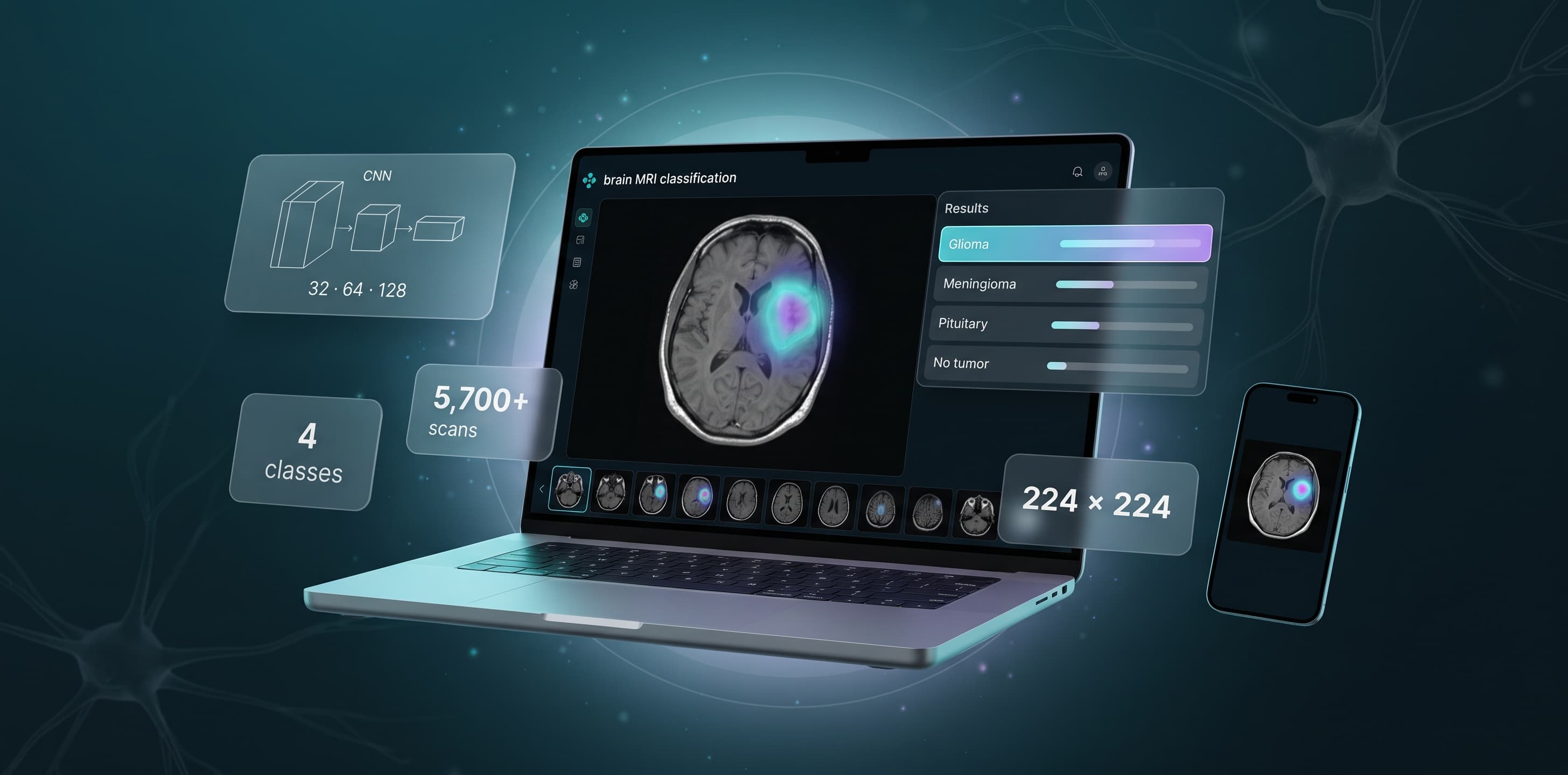
A custom 3-block CNN (32->64->128) with Batch Normalization and Global Average Pooling that classifies brain MRI scans into four tumor categories.
Technical Context
The Build Logic
Executive Summary
A computer-vision pipeline that classifies brain MRI scans into four categories (glioma, meningioma, pituitary, and no-tumor) using a custom convolutional neural network. The 3-block CNN (32 -> 64 -> 128 filters) uses Batch Normalization and Global Average Pooling and is trained on 5,700+ scans with targeted augmentation.
The Problem
Manual review of brain MRIs is slow and needs specialist radiologists. A reliable automatic classifier can triage scans and flag the likely tumor type for faster expert review — but medical-imaging models must generalise well and resist overfitting on limited data.
The Solution
- A custom 3-block convolutional network (32 -> 64 -> 128 filters) rather than a heavyweight pretrained backbone.
- Batch Normalization after convolutions for stable, faster training.
- Global Average Pooling instead of large dense layers to cut parameters and reduce overfitting.
- Targeted data augmentation (rotation up to 15 degrees) and plateau-based learning-rate decay.
System Architecture
-
Data & Augmentation Layer
MRI scans resized to 224 x 224, with rotation augmentation (up to 15 degrees) to widen effective sample diversity. -
Modeling Layer
A 3-block CNN (Conv -> BatchNorm -> ReLU -> Pool) at 32 -> 64 -> 128 filters, followed by Global Average Pooling and a softmax head over 4 classes. -
Training Layer
Plateau learning-rate decay down to a 1e-6 floor, with feature-map visualisation to inspect what each block learns.
Engineering Decisions
Why Global Average Pooling?
GAP collapses each feature map to a single value, drastically reducing parameters versus flattened dense layers and acting as a structural regulariser against overfitting.
Why Batch Normalization?
It stabilises activations across the 3 blocks, allowing higher learning rates and faster convergence.
Pipeline Details
Dataset: 5,700+ MRI scans across 4 tumor categories.
Input: 224 x 224 resolution with rotation augmentation up to 15 degrees.
Architecture: 3-block CNN, 32 -> 64 -> 128 filters, BatchNorm + Global Average Pooling.
Training: plateau learning-rate decay to a 1e-6 floor.
Outcome
A parameter-efficient CNN image classifier for brain-tumor MRI triage, built with an emphasis on regularisation and interpretability over raw model size.
Scalability is the only standard
Ready to integrate these levels of intelligence and performance into your own ecosystem?