Medical Diagnostic System Ver2
Executive Summary
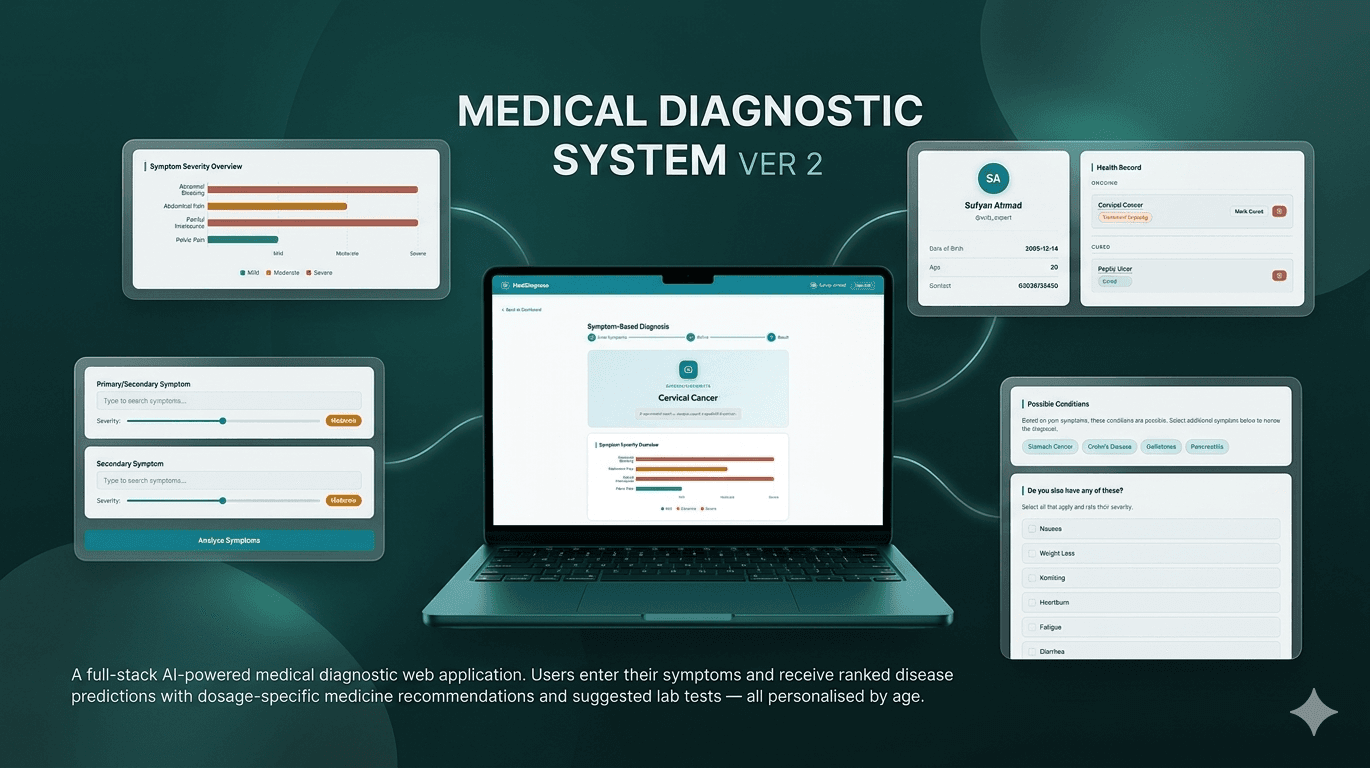
Medical Diagnostic System Version 2 was engineered to completely modernize its desktop predecessor, transforming a robust diagnostic engine into a highly accessible, full-stack AI web platform.
Technical Context
The Build Logic
Executive Summary
Medical Diagnostic System Version 2 was engineered to completely modernize its desktop predecessor, transforming a robust diagnostic engine into a highly accessible, full-stack AI web platform.
The objective was to build a scalable, clinical-grade SaaS application capable of:
- Mapping user-entered symptoms to accurate disease predictions
- Dynamically calculating patient-specific, age-aware medicine dosages
- Recommending specific clinical lab tests based on the diagnostic output
- Maintaining secure patient session histories
The system utilizes a highly sophisticated dual-engine approach, blending a dynamically built Random Forest Classifier with a probabilistic Bayesian-style scoring system, all powered by a Neo4j knowledge graph.
The Problem
Traditional digital symptom checkers face several critical issues:
- They rely on hardcoded decision trees that fail to account for overlapping symptoms.
- Medication recommendations are often generic, ignoring critical variables like the patient's age (child vs. adult vs. elderly).
- Desktop-bound applications severely limit accessibility for remote or mobile users.
- Medical data schemas in traditional SQL databases become overwhelmingly complex and slow when mapping many-to-many relationships between diseases, symptoms, and treatments.
There was a structural need for an accessible web platform capable of handling complex graph-based medical relationships and statistically sound inferences.
The Solution
Version 2 seamlessly integrates:
- A Neo4j cloud graph database optimized for medical relationship mapping.
- A Python/Flask backend acting as a secure AI orchestration layer.
- A React.js frontend delivering a modern, responsive user experience.
- A blended ML model utilizing data augmentation for higher diagnostic resilience.
The result is a powerful diagnostic tool that delivers:
- Top-N ranked disease predictions based on user inputs.
- Precise medicine dosage recommendations strictly categorized by age groups (<12, 12-64, 65+).
- Structured lab test suggestions linked to the predicted condition.
- A comprehensive, securely stored patient history via MongoDB.
System Architecture
-
Knowledge Graph Layer (Neo4j)
The entire medical corpus is structured as a graph:(Disease) -[:HAS_SYMPTOM]-> (Symptom)with precise weights and probabilities, alongside[:TREATED_BY]and[:DIAGNOSED_BY]relationships. -
Intelligence & ML Layer
A Random Forest classifier is built dynamically in RAM at server startup using data pulled from Neo4j.
Model training utilizes noise injection (data augmentation) for better real-world generalization.
A parallel Bayesian-style scorer ranks diseases by weighted symptom overlap, and the results are mathematically blended. -
Application Backend (Flask & MongoDB)
Python Flask provides RESTful APIs.
MongoDB Atlas securely stores user profiles, encrypted passwords (bcrypt), and historical diagnostic sessions. -
Presentation Layer
React.js utilizing React Router and custom CSS for a fluid, SPA experience.
Engineering Decisions
Why a Graph Database (Neo4j)?
Medical data is inherently highly connected. Graph databases allow traversal of complex relationships (Disease to Symptom to Medicine) exponentially faster than complex SQL JOINs.
Why a Dual ML Engine?
Relying purely on a classifier can lead to edge-case failures. Blending a Random Forest model with a probabilistic Bayesian overlap scorer ensures the output remains medically logical and highly resilient.
Why In-Memory Graph Loading?
Loading the Neo4j schema into memory at server startup drastically reduces API response times for end-users, facilitating near-instantaneous diagnostic inference.
Performance Metrics
Diagnostic inference latency: incredibly low due to in-memory graph models.
Knowledge graph traversal speed: optimized via Neo4j indexing.
Authentication security: 100% integration with bcrypt hashing protocols.
Responsive UI: zero page reloads during the multi-step diagnostic workflow.
Scalability Strategy
Decoupled architecture allows the React frontend, Flask API, and Neo4j database to scale independently.
MongoDB integration paves the way for complex patient data analytics.
Easily extensible graph schema to introduce new medical fields like allergies or genetic markers.
Outcome
Version 2 successfully bridges the gap between advanced probabilistic machine learning and an intuitive web interface.
It is architected as an enterprise-grade healthcare tool capable of delivering deeply personalized, age-specific medical guidance.
System Visuals
Scalability is the only standard
Ready to integrate these levels of intelligence and performance into your own ecosystem?